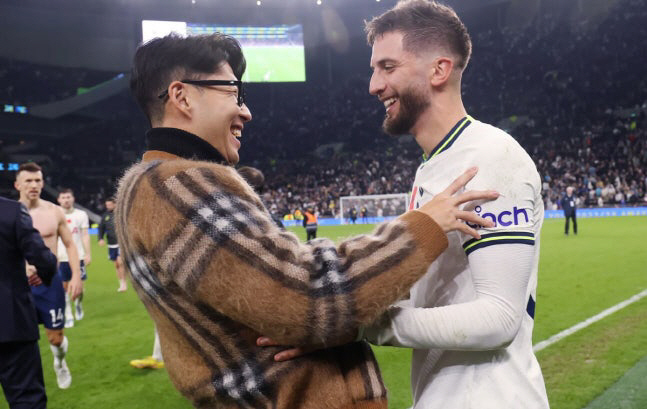
Recent events surrounding Tottenham Hotspur have cast a shadow over the team’s tactical stability and squad morale. In particular, the racism controversy involving Son Heung-Min and Rodrigo Bentancur’s critical injury present crucial vulnerabilities for the team. From a professional football analyst's perspective, this article delves deeply into the repercussions and tactical implications of these two critical issues on Tottenham.
Firstly, the racism controversy involving Son Heung-Min is not merely an off-field issue. The fact that the 'BBC' officially recognized this incident underlines its severity. Such external controversies can adversely affect not only the mental strength of the individual player but also the overall morale of the team. As Tottenham’s captain, Son Heung-Min is responsible for the team’s leadership. If he is embroiled in such unpleasant matters, it can detract from his focus on the game, potentially leading to a deterioration in performance. Teammates, too, may unconsciously feel stress from this situation. From a tactical standpoint, a captain’s psychological instability can impact team cohesion and tactical execution, possibly causing unexpected passing errors or defensive lapses.
Secondly, Rodrigo Bentancur’s complete hamstring rupture is nothing short of a 'disaster' for Tottenham's midfield. He is expected to be sidelined for at least three months, with surgery further extending his recovery period. Bentancur has been a key midfielder in Ange Postecoglou’s strategy. Considering his style of play, Bentancur has served as a transitional link in midfield, with robust pressing, ball-winning abilities, and initiating attacks with precise passes.
Analyzing the stats, Tottenham’s midfield dominance and build-up stability are noticeably better with Bentancur on the field. As a classic box-to-box midfielder, his work rate covers extensive defensive zones and includes offensive incursions and shooting ability. His absence will significantly diminish Tottenham’s dynamism and balance in midfield. The gaps emerge in breaking down opposition's press during build-up play, advancing the ball, and raising midfield density during defense to thwart attacks.
With this injury, Postecoglou is faced with a significant dilemma in midfield composition. Current midfield options such as Yves Bissouma, Pape Sarr, and Pierre-Emile Højbjerg find it challenging to perfectly emulate Bentancur's unique tactical value. Bissouma, as a holding midfielder, excels in defense but lacks Bentancur’s forward drive. Sarr offers energy and activity but lacks Bentancur’s experience. Højbjerg has stable passing and defensive skills, but doesn’t equate to Bentancur’s speed in transitions or his dribbling capability to break press.
Ultimately, Bentancur’s prolonged absence threatens Tottenham with loss of midfield dominance. Opponents will intensify the pressure on Tottenham’s midfield weaknesses, potentially leading to increased errors or turnovers during build-up. Defensively, weakened midfield pressure will make protective shielding of the defensive line difficult, increasing the burden on center-backs and full-backs. Offensively, Bentancur’s forward passes and link-up play, which facilitated attack progression, will be missed, possibly resulting in inadequate service to forwards like Son Heung-Min, Richarlison, and Kulusevski.
Such scenarios pose serious obstacles to Tottenham’s ambition for Champions League qualification this season. Postecoglou’s tactical changes to compensate for Bentancur’s absence are intriguing — whether adapting from a 4-3-3 system to alternatives or assigning new roles to existing players, a breakthrough is needed. However, covering for a key player like Bentancur in the short term is no easy task.
In a comprehensive view, the psychological burden from the racism controversy involving Son Heung-Min and the critical injury of Bentancur pose a double hardship for Tottenham Hotspur, significantly impacting tactical stability and season objectives. This is a pivotal moment where the coach and squad must display greater mental resilience and flexible tactical responses to overcome these challenges.