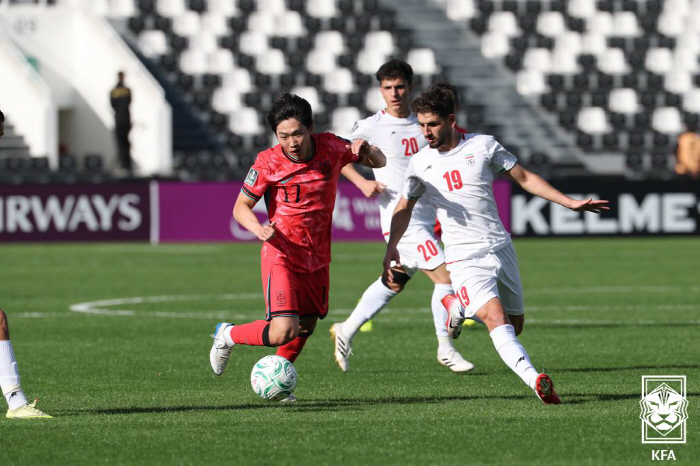
The Korea U-23 national team's first official match of 2026 took place at Al Shabab Club Stadium in Riyadh, Saudi Arabia. This fixture, a precursor to the AFC U23 Asian Cup finals, ended the first half at 0-0, showcasing a tense struggle between the two teams. From a tactical standpoint, both teams utilized a 4-4-2 formation, focusing on midfield battles and exploiting the flanks.
Korea exhibited an aggressive intent from the start, trying to seize control. Notably, Korea attempted to destabilize Iran's defense through intense pressing and swift transitions. Their efforts seemed to bear fruit in the 19th minute when striker Tae-won Kim appeared to score, only for the goal to be disallowed due to an offside call, missing a critical opportunity to sway the game's momentum.
A significant observation from this match is Korea's defensive vulnerabilities despite their attacking attempts. Particularly, a lack of focus during set-piece situations emerged as a distinct weakness throughout the first half. Iran capitalized on these weaknesses, effectively wielding counter-attacks and set pieces to threaten Korea's goal.
The biggest game changer occurred in the 26th minute. Known as the 'second Ji-sung Park,' Sang-yun Kang suffered a left knee injury, forcing a substitution with Seung-bae Jung. Kang's injury represents more than just the loss of a single player. His energy, ball retention skills, and ability to connect play between attack and defense made him a crucial tactical asset. His absence could weaken midfield distribution and pressing intensity.
Following Kang's unexpected departure, Korea's squad showed signs of destabilization, reflected in Hyun-yong Lee receiving a yellow card amid evident psychological distress. Iran, sensing opportunity, intensified pressure, increasing ball possession and control in Korea's half as the half drew to a close.
Analyzing the first half reveals Korea U-23's chronic issue with ineffective finishing, exemplified by Kim's disallowed goal and a lack of shots on target. Moreover, Kang's injury significantly impacted the team's overall gameplay, highlighting the urgent need for strategies against Iran's set-piece threats.
The remaining 45 minutes present a critical tactical challenge for the Korean team. The coach's strategic adaptations will be intriguing, focusing on mitigating Kang's absence and countering Iran's offensive strategy, which will likely determine the match outcome. Enhancing midfield ball possession, maximizing flank attacks, and showing organized defensive movements in set-piece scenarios are pivotal strategies moving forward.
@KoreanU23 @AFC_U23_Asian_Cup @SangYunKang @TaeWonKim @FootballTacticsAnalysis