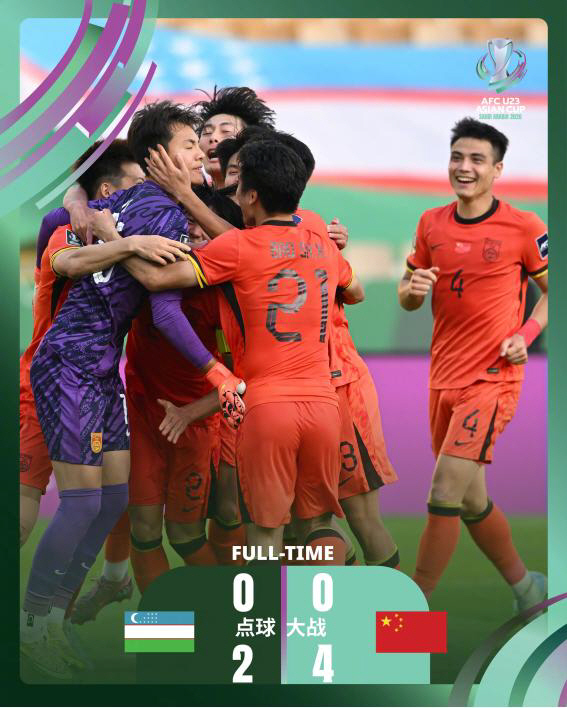
Recently, during the AFC U-23 Asian Cup, the unexpected performance of China's U-23 team has stirred intense interest in football across the nation, leading to an outpouring of confidence that seems excessive. Chinese media have speculated about the potential of their goalkeeper moving to Europe and have even made provocative comments such as saying "Korea is a lesser team than Uzbekistan." Furthermore, they claim they have "consistently defeated Korea" in past encounters, which seems quite exaggerated. Is this an accurate reflection of Chinese football's current status, or merely another warning shot to Korean football? We aim to delve into this situation with a professional lens.
In the recent U-23 Asian Cup, the Chinese squad made headlines by reaching the semifinals after a thrilling penalty shootout victory over strong contenders Uzbekistan. The star of the match was undoubtedly goalkeeper Li Hao, who delivered a stunning performance by keeping a clean sheet throughout the 120 minutes of regulation and extra time and excelled in the penalty shootout, leading his team to the semifinals. Chinese media outlet Sohu.com praised Li Hao and claimed he deserved a place in Europe's top five leagues, eagerly anticipating his international career. Remarkably, the Chinese U-23 team boasted 390 minutes of clean sheets across four matches, including group stages, showcasing a solid defensive effort complemented by Li Hao's individual talent. Nonetheless, a closer look at the match indicates Uzbekistan had 71% ball possession and over 20 shots, whereas China had only 29% possession and took merely six shots, emphasizing the defensive stance they adopted throughout the game. Hence, their success can be attributed to defense-oriented tactics combined with extraordinary goalkeeping.
Fueled by this success, the Chinese media have unleashed a wave of provocative statements regarding Korean football. Sohu.com claimed that Korea's U-23 team, which was soundly defeated 0-2 by Uzbekistan and only narrowly drew against Iran, struggled to advance from the group stage and argued that Korea is now ranked in the middle-lower tier in youth categories, falling behind Japan and Uzbekistan. They asserted, "China would have preferred facing Korea over Uzbekistan in the quarterfinals," suggesting Korea is considered an easier opponent. In reality, Korea's U-23 team did exhibit lackluster performances against Uzbekistan, and both Japanese media and fans mocked their quarterfinals entry as 'fortunate.' This highlights the urgent need for a thorough reevaluation of Korea's youth football competitiveness.
However, is this confident rhetoric from the Chinese media a truly accurate assessment of Korean football? Particularly "Korea, we always beat them" is a claim far from the historical facts. Evaluating the all-time results between the national teams of Korea and China, Korea holds a commanding lead. As of June 11, 2024, Korea has an overwhelming record of 24 wins, 13 draws, and only 2 losses (or 22 wins, 13 draws, and 2 losses) against China. Excluding draws, Korea boasts an impressive 92.3% winning rate. China's victories during the 2010 East Asian Football Championship (0-3) and the 2017 World Cup Qualifiers (1-0) were rare instances. Historically, Korea has long maintained dominance, enough to coin the term 'Korean phobia' symbolizing China's long-standing difficulty against Korea. Therefore, these claims by the Chinese media are simply an overstatement that distorts objective data and history.
From a tactical perspective, China's defense-focused pragmatic play and reliance on their goalkeeper's individual prowess seen in the U-23 Asian Cup might work in short-term tournaments but are unlikely to ensure long-term success. Consistently winning with less than 30% possession and a significantly low number of shots is not sustainable. Conversely, Korea's struggle against Asian powerhouses like Uzbekistan and Japan highlights an essential task. This is not merely about a few matches but demands deep reflection on the youth and development systems in place. As the importance of young players gaining European experience strengthens, it is crucial for Korea to not be distracted by China's temporary success and self-praise but instead focus on maintaining its strengths and addressing weaknesses.
In conclusion, China's impressive performance in the U-23 Asian Cup, particularly Li Hao's standout contributions, is noteworthy. However, using this to diminish the entirety of Korean football or to propagate historical inaccuracies should be approached with caution. On the senior national team level, Korea remains dominantly superior to China, and the 'Korean phobia' is a profound part of the history that won't easily fade. Nonetheless, the performance issues evident at the U-23 level should serve as a constructive warning for Korean football to revamp its youth development systems and incorporate tactical diversity from the grassroots up.
@ChinaFootball @KoreaFootball @U23AsianCup @LiHao @KoreanPhobia @TacticalAnalysis