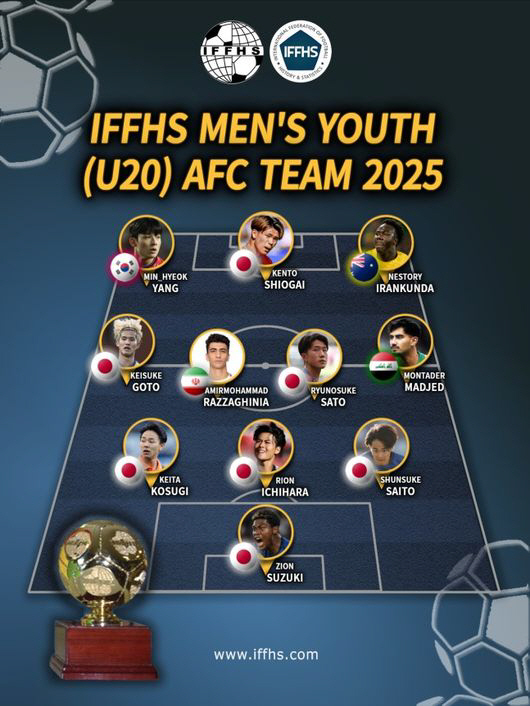
The recent announcement of the Asian Football Confederation (AFC) Youth Team of the Year results has sent a strong message to Korean football, calling for deep reflection. In this selection, which ranks the best talents in Asian youth football, only one Korean player was included, while Japan boasted an impressive seven players, highlighting a stark contrast between the two countries. This difference goes beyond mere numbers, serving as a crucial indicator of the current and future states of youth football systems in both nations.
The AFC Youth Team of the Year is an authoritative list recognizing young players with the potential to lead the future of Asian football. Inclusion in this list signifies exceptional individual talent, high potential for future development, and a testament to the excellence of their league’s or nation’s youth system. Thus, the glaring 1-to-7 disparity between Korea and Japan forces a candid acknowledgment of the reality facing Korean football today. Although five Korean players made the list back in 2023, the gap began to widen from 2024, leading to Japan’s dominant majority by 2025, a trend that warrants attention.
From a tactical standpoint, producing elite players across various positions at the youth level directly affects the tactical flexibility and depth of the senior national team. Japan's balanced output across all positions, from forwards to midfielders, defenders, and goalkeepers, suggests a well-rounded talent pool, laying a foundation for experimenting with diverse tactical changes and styles in the future. In contrast, reliance on specific positions or the scarcity of certain types of players can limit a national team's tactical diversity in the long run.
Through these results, we must critically examine the issues within Korea’s youth football system. The Korea Football Association (KFA) and K-League clubs have invested significant efforts in youth development, producing world-class players like Son Heung-min, Kim Min-jae, and Lee Kang-in. Efforts to improve the system, such as launching K-League youth teams, adopting overseas academy models, and offering coach training programs, have been ongoing. However, persistent issues such as the coexistence of school football and club football, intense training schedules, an overemphasis on performance, and a tendency towards elite education remain problematic. There are growing calls for a systemic change that focuses on holistic development and enjoyable football, under the philosophy that "players come before results."
In Japan, a broad-based expansion of youth football and a systematic nurturing system based on “enjoyable football” have long been established. With the launch of the J-League, the mandatory operation of youth football clubs, and the simultaneous focus on academics, football, and character education, Japan adopts a long-term perspective in player development. Additionally, a coaching system fostering passion for football from a young age and allowing players to find interest independently is viewed as a key factor in their success. The effort to offset physical limitations through mixed-heritage players and discover a variety of player types is also notable. These systemic approaches have ultimately resulted in many players being selected for the AFC Youth Team of the Year.
This outcome should not be dismissed as a solitary incident. It might reveal structural and systemic issues that could threaten the future of Korean football. While it might not immediately alter the current strength of the senior national team, the competitive edge of Korean football five to ten years from now will be determined by the current operation of the youth system.
Therefore, Korean football must take these results seriously and pursue profound reflection and bold innovation. Focus should be given to qualitatively enhancing youth coach training and education programs, introducing training methods that respect the creativity and autonomy of individual players, improving the synergy between school and club football, and, above all, creating an environment where football can be enjoyed as part of player growth. Rather than being fixated on short-term outcomes, it is time to redraw the blueprint for the long-term future of Korean football akin to Japan’s approach. Hopefully, this result serves as a critical turning point for Korean football evolution.
@KoreanFootball @JapaneseFootball @YouthFootball @AFCYouthTeamoftheYear @FootballTacticsAnalysis