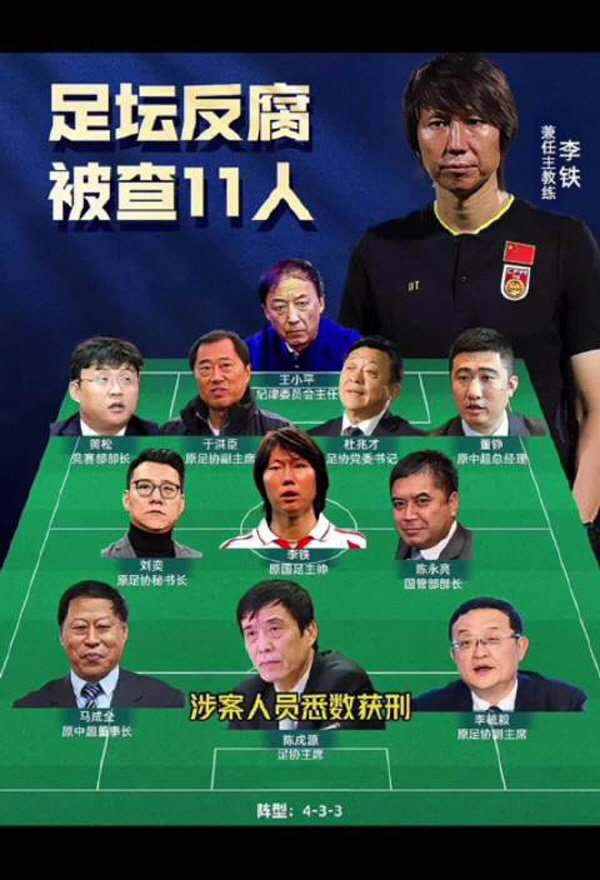
Recent unprecedented large-scale corruption scandal that has shaken Chinese football is more than just a transgression; it is a shocking event that signals a systemic collapse. The involvement of high-ranking officials from the Chinese Football Association, coaches, and even national team players has delivered a massive shockwave to football fans worldwide.
Initially, it was announced that 133 individuals would face disciplinary action. As of January 29, 2026, a total of 73 key figures have been permanently banned from all football-related activities. This severe punishment demonstrates China's strong commitment to eradicate match-fixing and illegal gambling. Among those permanently banned are high-profile figures like the former Chinese Football Association president Chen Xuyuan and former national team coach Li Tie, highlighting the deep and extensive roots of the corruption.
This massive disciplinary action is the result of a thorough investigation into wide-ranging corruption including match-fixing, illegal gambling, and various illegal transactions. Such corruption is not merely a personal deviation but is considered a grave criminal act that thoroughly undermines the league's integrity and the spirit of sportsmanship. From a tactical standpoint, the manipulation of match results by external factors negates the very essence of football, and inevitably hampers both teams’ strategic operations and players' skill development.
Moreover, it is noteworthy that 13 professional clubs received collective sanctions. These clubs primarily belong to the Chinese Super League (CSL) and League One, and they were penalized with point deductions and hefty fines. Particularly, Shanghai Shenhua and Tianjin Jinmen Tigers faced a 10-point deduction, and Shanghai Port was also punished with a 5-point deduction and fines ranging from 200,000 to 1 million yuan. Statistics show that these point deductions have a direct impact on league standings, severely affecting clubs' season goals while also imposing financial pressure, thus complicating club operations.
This disciplinary measure is not just a short-lived effort but part of a continuous purification process of Chinese football that has been ongoing since 2024. Considering the numerous permanent bans in September 2024, it can be interpreted that the Chinese authorities aim for fundamental reform of the national football system, beyond simply punishing a few individuals. This is a necessary process for Chinese football to regain international trust and foster leagues and national teams with competitive edge in the long-term.
In football, where tactical changes by the coach and player positioning are key, the inclusion of match-fixing as an external variable renders all tactical efforts meaningless. In such an environment, no matter how talented players are discovered in the youth system, structural issues arise where their growth within fair competition is challenged. Therefore, this action is expected to be a significant turning point determining the long-term development direction for Chinese football. Ensuring league transparency and creating a fair competitive environment are essential elements for regaining fans’ trust and establishing a culture where players are evaluated purely based on skill.
In conclusion, this large-scale purging of corruption in Chinese football showcases unprecedented determination in both scale and scope. Authorities' resolute message to eradicate match-fixing and illegal gambling signifies a new dawn for Chinese football. It remains to be seen whether such severe disciplinary actions will bring about genuine reform, and what positive changes they might lead to in the long run. Restoring league fairness and fostering a healthy football culture is the only path for Chinese football to be recognized once again on the world stage.
@ChineseFootball @CFA @MatchFixing @Corruption @ChineseSuperLeague @FootballNews